Contributed by guest writer Ramesh Ranjan
In brief: HR has evolved from a Personnel department focused on hiring, payroll, compliance and discipline into a business partner expected to understand commercial context and demonstrate impact. Dave Ulrich (1997) framed four HR roles, Business Partner, Change Agent, Employee Champion and Expert Administrator, and many organisations adopted a three-spoke model of HR Business Partners, Centres of Expertise and HR Shared Services. Leaner structures, more self-service, a stronger employee-experience focus and greater technology fluency are expected next.
For years the Human Resources department was known as the Personnel department. They were primarily employed for hiring the workforce, determining wages, managing their payroll, ensuring compliance to complex laws of the land, managing records and ensuring discipline.
Over the years, the HR department has evolved tremendously. In fact, the HR department has gone through dramatic changes in this century. The emergence of Digital Technologies has led to the emergence of a slew of technologies that automate much of the work traditionally done by the HR department.
HR function has moved from being a Personnel Department to become a Business driven HR that supports the Business in achieving its stated objectives.

How the HR Role Has Transformed
The HR role itself underwent some transformation from;
Personnel (Control) – Maintaining Compliance & control of People processes
Human Resources (Services) – Providing effective People services
Talentship (Builder) –Attracting, retention and development of Talent and leverage competitive advantage through People
Reliable Business Partner (Decisions)– Focus on improving organisational decision related to the People side of Business
Towards the end of last century, HR thought Leader Dave Ulrich advocated 4 roles for HR and led to the transformation of HR (Ulrich, 1997). The 4 roles that HR professionals don in an organisation is as follows :
The Business Partner
The Change Agent
The Employee Champion
Expert Administrator
Originally the HR professionals were required to be HR Generalists and be like a “Jack of all Trades and master of none”. But over the years with HR integrating into Business, they needed special skills to be able to support business.
The expectations from the Business Leaders were
• Speak my language- understanding business context & strategising with business
• Add value, earn credibility - demonstrating business impact
• Break the HR silo
• Help shape the culture
• Developing multi-disciplinary skills
• Anticipating change
• Befriending technology
• Focusing on insights
The workforce demographics has also changed to a great extent. We are dealing with a young, knowledgeable and aspirational workforce and hence the demands on HR is changing rapidly.
HR has moved to a value driven HR organisation model. HR has to create a more strategic role for HR within the enterprise. It has to ensure that it provides flawless administration of HR services and be able to Connect the People in the organisation and build synergy. Hence the role of HR has changed dramatically. HR had to move up the value chain and be seen more strategic than just tactical.

This led to the rethink of the way HR was organised. Hence the emergence of a new HR Model and also the birth of the HR Shared Services.
The Three-Spoke HR Model
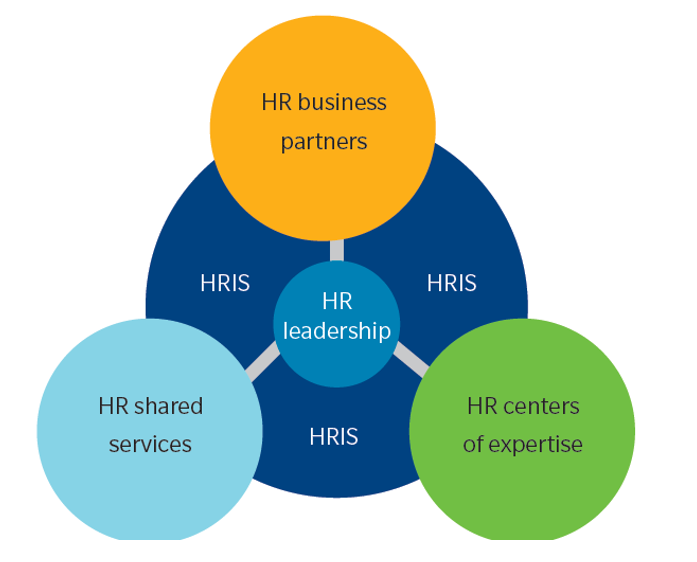
The HR Department was divided into 3 significant roles.
HR Business Partner
Contribute to the design of organisations (skills, resources, processes)to suit business challenges
Coordinates the resources I business and Master high-performance solutions (cost, quality , time)
Steer the implementation of change management operations
Coordinate and guarantee that processes as well as HR programmes are being correctly carried out around Group values
Manage labour relations and legal aspects for the entity
HR Centres of Expertise
Internal consultants providing Solutions to leaders and HR BP
Solutions to build globally aligned and competitive Compensation and Benefits, Learning & Development, Talent management
Cost and vendor reductions
Design Communication to managers and employees in their field
Design tools and processes in their field: Bridge HR modules,..
HR Shared Services
Deliver services in Payroll, Administration (inc. L&D delivery ), Sourcing , Mobility
Reward Operations: Run data gathering, implement compensation changes
Drive Global HR transformation program & deploy SSC's to optimize efficiency and costs
Deploy HR tools: IS strategy , Employee direct. Call Centres, HR Metrics & Data quality
How Does the Future of HR Look?
With the rapid advancement in Technology and Digital disruption, the existence of HR was being questioned and coming under threat. Management thinker Ram Charan has argued that HR as traditionally structured should be dissolved and rebuilt around leadership and organisation (Charan, 2014). Charan argues that HR needs to make the same leap as Finance and become a true partner to the CEO & Business Leaders. In 2014 he argued that it was time to, “say good-bye to the Department of Human Resources” (Charan, 2014) and split it into two strands: one focused on HR – Administration, and the other focused on HR – Leadership and Organisation, which is responsible for improving people capabilities. HR will need to relook at its role, strategy and how it is delivering value to its stake holders.
Role
Function will exist!
From Efficiency to Employee experience orientation
Leaner structure
More strategic role of HR Business Partners
HR–Business Interplay
Engage with business to add maximum value
From - Helper’ to ‘Doctor’
From ‘Inside-out’ to ‘Outside-in’
Delivery Model
Self-service operations
Greater & deeper roles for Centres of Excellence
Cut bureaucracy – reduce cycle time
Tasks and Responsibilities
Multidisciplinary
Guardian of talent
Manager of free agents
Own business responsibilities & run HR like a business
Tweak roles and responsibilities to suit changing business requirements.
Process champion to Guardian of employee experience
From Doing-all to Doing-only-what- matters-most
New-Age Skills
Adopt technology tools for more efficient processes and data-driven insights for better decision-making.
From Tech-shy to Tech-friendly
HR is here to stay and has a very significant role to play in shaping the Future of Work.
Linq HR provides fractional employee relations support to Australian employers and operates Workforce Directory, Australia’s HR services marketplace. Ph 1300 234 566.
Further reading:The Future Structure of HR Departments in an AI-Enabled Era and Why the HR Business Partner Role Is in High Demand.
----------------------------------------------------------------------------------
Ramesh Ranjan
March 2021
References
Charan, R., 2014. It’s time to split HR. [online] Harvard Business Review, July–August. Available at: https://hbr.org/2014/07/its-time-to-split-hr
Ulrich, D., 1997. Human Resource Champions: The Next Agenda for Adding Value and Delivering Results. Boston: Harvard Business School Press.